
Travel Tips
Exploring the Fjords of Norway: A 2026 Journey Through Landscapes
Geirangerfjord's two-hour fjord cruise runs about 590 NOK as of September 2026, and you can cover Norway's best fjords by rental car and ferry without booking a single cruise ship cabin.

-
01 / Verified & updated
September 2026
-
02 / Base hub
Flam, the starting point for the Flam Railway
-
03 / Primary transit
The Norway in a Nutshell route: train to Flam, ferry through Naeroyfjord to Gudvangen, then bus back, budgeted as a full day
-
04 / Verified cost
A two-hour fjord cruise from Geiranger village runs roughly 590 NOK per adult, and a Lysefjord boat tour from Stavanger runs about 590 to 890 NOK for two to three hours, as of September 2026
-
05 / Crowd-free window
Book the Geiranger-Hellesylt or Flam-Gudvangen ferry a few days ahead in July and August since both routes sell out during peak season
-
06 / Region
Travel Tips
-
07 / Read time
11 min
Norway's fjords are the reason half of Scandinavia's tourism industry exists, and honestly, photos don't do them justice. You can stare at a thousand shots of Geirangerfjord online and still gasp out loud when you round a bend on Route 63 and see it in person. This guide breaks down which fjords actually deserve your limited vacation days, how to string together a route without joining a cruise ship packed with 3,000 strangers, and what it's going to cost you as of September 2026.

Why Norway's Fjords Are Worth the Trip in 2026
Fjords aren't just pretty inlets. They're scars left by glaciers that ground through solid rock during the last ice age, then filled with seawater once the ice retreated roughly 10,000 years ago. That's why the walls rise so sharply from the water, sometimes over 1,000 meters straight up, while the water itself can drop past 500 meters deep in the same stretch. You're basically standing in a drowned canyon, and the scale messes with your sense of distance in a way that's hard to describe until you're there.
Norway also tightened its act on fjord tourism heading into 2026. The Norwegian Maritime Authority's zero-emission requirement for cruise ships in the World Heritage fjords (Geirangerfjord and Nærøyfjord) took effect at the start of 2026, so the big ships idling and belching diesel fumes over the water are mostly gone. It's quieter, cleaner, and honestly a better experience if you were on the fence about visiting because of the cruise crowds.
And the landscapes themselves are just different from anything you've hiked or driven through elsewhere. Vertical rock faces, waterfalls that drop straight into saltwater, farms clinging to ledges that shouldn't be farmable. If you've done granite peaks in South America, it's worth comparing notes with the Best Mountains in Bolivia for Hiking: 2026 Trekking Guide, though Norway trades altitude sickness for constant drizzle.
Geirangerfjord and Nærøyfjord: The Iconic UNESCO Fjords
These two get all the postcard attention, and for good reason. Both are UNESCO World Heritage Sites, both are absurdly photogenic, and both are compact enough to see properly in a day or two.
Geirangerfjord stretches about 15 kilometers and is famous for the Seven Sisters waterfall cascading down one side while a single, isolated waterfall known as the Suitor faces it from the other. Stop at Flydalsjuvet for the classic overlook shot, then drive the switchbacks up to Ørnesvingen (the Eagle Road) for a wider angle. A two-hour fjord cruise from Geiranger village runs roughly 590 NOK per adult as of September 2026, but check the official Visit Norway site before you book since operators adjust pricing seasonally.
![[Naerofjord (I.E., NæRøYfjord) From Gudvangen, Sognefjord, Norway] [Between Ca. 1890 And Ca. 1900]. 1 Photomechanical Print : Photochrom, Color. Notes: Title From The Detroit Publishing Co., Catalogue J--Foreign Section. Detroit, Mich. : Detroit Publishing Company, 1905. Print No. 7050. Forms Part Of: Landscape And Marine Views Of Norway In The Photochrom Print Collection. Subjects: Norway--Sognefjord. Format: Photochrom Prints--Color--1890-1900. Rights Info: No Known Restrictions On Publication. Repository: Library Of Congress, Prints And Photographs Division, Washington, D.C. 20540 USA, Http://Hdl.Loc.Gov/Loc.Pnp/Pp.Print Part Of: Landscape And Marine Views Of Norway (DLC) 2001699563 More Information About The Photochrom Print Collection Is Available At Http://Hdl.Loc.Gov/Loc.Pnp/Pp.Pgz Persistent URL: Http://Hdl.Loc.Gov/Loc.Pnp/Ppmsc.06209 Call Number: LOT 13432, No. 107 [Item]](https://images.pexels.com/photos/25912183/pexels-photo-25912183.jpeg?auto=compress&cs=tinysrgb&w=1200)
Nærøyfjord is the narrower, wilder cousin, a branch of Sognefjord that's only 250 meters wide at its tightest point. The cliffs here feel closer, almost claustrophobic in a good way, and abandoned farms dot the slopes where families once lived without road access. The classic move is the Norway in a Nutshell route: train to Flåm, ferry through Nærøyfjord to Gudvangen, then bus back. Budget a full day and don't rush it.
Pro Tip: Book the Geiranger-Hellesylt or Flåm-Gudvangen ferry a few days ahead in July and August. Both routes sell out during peak season, and the walk-up line at the dock is not where you want to find that out.
Sognefjord, Hardangerfjord, and Lysefjord: Norway's Other Major Fjords
Sognefjord is the big one, Norway's longest fjord at 205 kilometers, stretching from the coast near Bergen all the way inland past glaciers and orchard towns. Nærøyfjord and Lustrafjord both branch off it, so a lot of your Geiranger-area itinerary technically touches Sognefjord without you realizing it.
Hardangerfjord is the one locals actually vacation on. It's softer than Geiranger, lined with apple and cherry orchards that bloom in May, and home to the thundering Vøringsfossen waterfall near Eidfjord. If Geirangerfjord felt like a highlight reel, Hardangerfjord feels like real life, farms, small towns, less scripted.
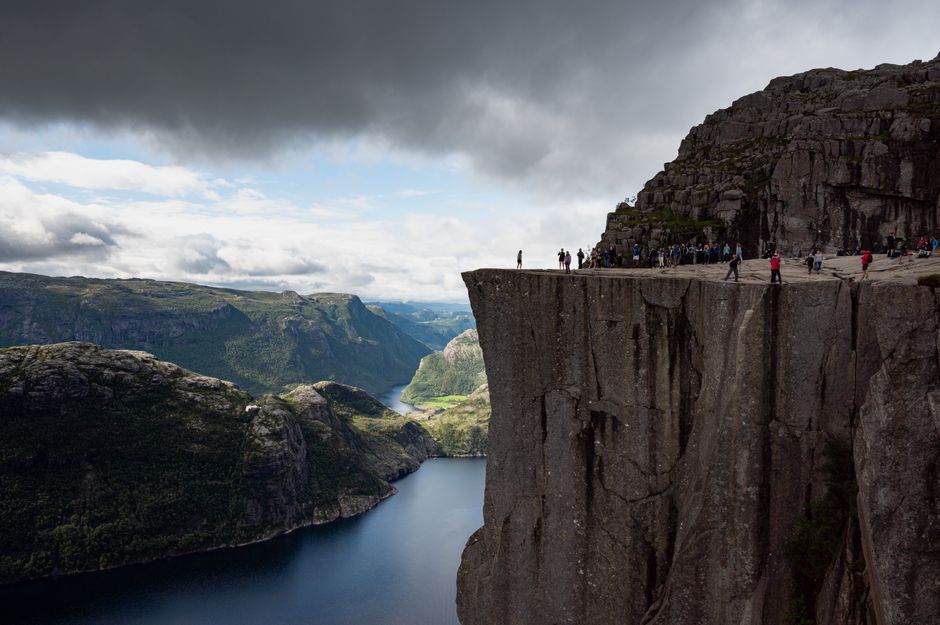
Lysefjord, near Stavanger, is the drama queen of the group. This is where you'll find Preikestolen (Pulpit Rock) jutting 604 meters above the water and Kjeragbolten, a boulder wedged between two cliff faces that thrill-seekers stand on for the photo. A boat tour through Lysefjord from Stavanger runs about two to three hours and costs somewhere between 590 and 890 NOK depending on the operator, current as of September 2026.

- Sognefjord: longest and most varied, good base for glacier hikes near Jostedalsbreen.
- Hardangerfjord: orchards, waterfalls, and fewer tour buses.
- Lysefjord: the closest fjord to Stavanger and easiest to combine with a short weekend trip.
Coastal Villages Worth a Stop: Flåm, Undredal, and Reine
Flåm is small, maybe 350 permanent residents, but it punches way above its weight as a transit hub. It's the starting point for the Flåm Railway, one of the steepest standard-gauge train lines in the world, dropping 866 meters over 20 kilometers with a stop at Kjosfossen waterfall. Most people pass through, but staying one night lets you catch the village without the day-trip crowds.
Undredal, a short ferry or drive from Flåm, has around 80 residents and more goats than people. It's known for goat cheese and a 12th-century stave church that seats about 40. Stop at the local dairy if it's open, the cheese is genuinely good and you won't find it exported far beyond the region.

Reine, up in the Lofoten Islands, is technically north of the classic fjord belt but it's become shorthand for the whole fishing-village aesthetic: red and white cabins on stilts over the water, jagged peaks behind them. It's a haul to get there (fly to Bodø, then drive or bus into Lofoten), but if you're already chasing dramatic coastlines and maybe the northern lights, it's worth the extra two or three days. If village-hopping is your thing, the Best Villages in Fiji to Visit in 2026: Real Culture, No Resorts guide covers a similar low-key, skip-the-resort approach on the other side of the planet.
Mountain Viewpoints and Hikes for Fjord Panoramas
The best fjord views almost always come from above, which means putting in some legwork. Here's what's worth the sweat.
- Preikestolen: 8 kilometers round trip, 3-4 hours, moderate difficulty. The payoff is standing on a flat rock ledge with a sheer 604-meter drop to Lysefjord below.
- Trolltunga: 27 kilometers round trip, 10-12 hours, genuinely tough. The reward is a tongue-shaped rock jutting out over Ringedalsvatnet with Hardangerfjord views in the distance. Start before 6am in summer.
- Kjeragbolten: 12 kilometers round trip, similar difficulty to Trolltunga, includes chain-assisted rock scrambles.
- Dalsnibba: no hike required, just a toll road (around 130 NOK per car as of 2026) up to 1,500 meters for a bird's-eye view over Geirangerfjord.
- Aksla viewpoint in Ålesund: 418 steps from the town center, doable in 20 minutes, great for a lower-effort payoff.
"The fjord doesn't look real until you've stood above it and watched a cruise ship shrink to the size of a matchbox."
How to Get Around: Ferries, the Coastal Express, and Scenic Drives
You've got three real options, and they're not mutually exclusive.
The Coastal Express (Hurtigruten)
The classic Bergen to Kirkenes voyage runs along the coast for 12 days, hitting 34 ports along the way, with shorter segments available if you don't want the full run. It's less about diving deep into any single fjord and more about seeing the whole coastline unfold, plus it's one of the easier ways to tack on an Arctic add-on. Combine a Hurtigruten leg with a hop north to Tromsø or Svalbard for northern lights season (late September through March) and you've got a fjords-plus-Arctic trip without chartering a private expedition.
Ferries and express boats
Local ferries are the backbone of fjord travel and often cheaper than tours. Public ferries operated through the national ticketing system run on fixed schedules and let you self-drive onto the boat with your rental car, which is usually the most cost-effective way to cross a fjord rather than drive around it.
Scenic drives
Norway's National Tourist Routes are a network of 18 signposted scenic roads specifically built to slow you down and put you at the best viewpoints, similar in spirit to how road-trippers plan around Canada's iconic drives (see the Top 20+ Must-See Destinations in Canada 2026: Ultimate Guide if you're weighing a different continent for your next self-drive trip). Route 63 (Geiranger to Trollstigen) and Route Aurland (Lærdal to Aurland via Stegastein viewpoint) are the two you shouldn't skip.
When to Visit and What It Costs in 2026
Peak season is June through August: long daylight, most ferries and hikes running full schedules, and the highest prices. May and September are the sweet spot, thinner crowds, still-open trails, and noticeably lower hotel rates. Winter (November to March) closes most hiking trails and some ferry routes reduce frequency, but it opens the door to northern lights further north.
Rough budget as of September 2026, always double-check current rates on operator sites before booking:
- Budget travelers: 800-1,200 NOK per day covering hostel beds, groceries, and public ferries.
- Mid-range: 2,000-3,000 NOK per day for a rental car, guesthouse stays, and a couple of paid fjord cruises.
- Higher-end: 4,000+ NOK per day for boutique lodges, private boat tours, and Hurtigruten cabin upgrades.
Note: Norway isn't cheap, full stop. Alcohol, restaurant meals, and taxis all run higher than most of Western Europe. Groceries and self-catering cabins are where you actually save money.
Planning Your Fjord Itinerary: Sample Routes for 5-10 Days
Here's how to structure it depending on how much time you've got.
5 days, Bergen-based loop
Fly into Bergen, day trip to Hardangerfjord (2 days), then do the Norway in a Nutshell route through Flåm and Nærøyfjord (2 days), and spend your last day in Bergen itself wandering the Bryggen waterfront.
7-8 days, Bergen to Geiranger
Start in Bergen, work through Sognefjord and Nærøyfjord, overnight in Flåm and Undredal, then drive north via Route Aurland and Route 63 to Geiranger. Finish with Dalsnibba and a Geirangerfjord cruise before flying home from Ålesund.
If you've got extra runway after this and want to keep the castle-and-scenery streak going elsewhere in Europe, the Best Castles in Germany: 2026 Guide to Fairytale Fortresses and Best Castles in Romania 2026: Medieval Fortresses & Royal Palaces guides both pair well with a Norway trip if you're routing through the continent anyway.
10 days, full loop plus Lysefjord
Add Stavanger and Lysefjord onto the 7-8 day route above, flying into Stavanger first for Preikestolen or Kjeragbolten, then busing or flying up to Bergen to pick up the rest of the loop. This is the version that actually covers all five major fjords in this guide without feeling rushed.
Frequently Asked Questions
What is the most beautiful fjord in Norway?
Most travelers rank Geirangerfjord first for sheer photogenic drama, with Nærøyfjord a close second for its narrow, wild feel. It's genuinely subjective though. Hardangerfjord wins if you'd rather see orchards and small farms than cliffside waterfalls.
How many days do you need to see the Norwegian fjords?
Five days covers the Bergen area fjords comfortably. Give yourself 7 to 10 days if you want Geiranger, Lysefjord, and the coastal villages without constant driving fatigue.
What is the best time of year to visit the Norway fjords?
Late May through September is when everything is open and accessible. June through August is warmest and busiest, while May and September trade a few degrees for much smaller crowds and lower prices.
Can you visit the Norwegian fjords without a cruise?
Yes, easily. Public ferries, rental cars, and trains like the Flåm Railway cover almost everything a big cruise ship would show you, usually for less money and with more flexibility on timing.
How much does a trip to the Norwegian fjords cost in 2026?
Budget travelers can get by on roughly 800-1,200 NOK per day, mid-range trips run 2,000-3,000 NOK per day, and that's before international flights. Check current ferry and tour pricing on Visit Norway since rates shift by season.
Which fjord is closest to Bergen?
Sognefjord and its branches (including Nærøyfjord) are the closest major fjord system to Bergen, reachable within a couple of hours by train, bus, or car.
Pick two or three fjords, not all five. That's the single biggest mistake people make planning this trip, trying to cram Geiranger, Sognefjord, Hardangerfjord, and Lysefjord into one week and spending half of it in a rental car instead of standing at a viewpoint. Slow down, pick a route, and let the scenery do the work.
Common questions
- 01 What makes Geirangerfjord and Naeroyfjord special?
- Both are UNESCO World Heritage Sites and are compact enough to see properly in a day or two. Geirangerfjord stretches about 15 kilometers and features the Seven Sisters waterfall facing a single waterfall called the Suitor, while Naeroyfjord narrows to just 250 meters at its tightest point.
- 02 Has anything changed about cruise ships in the fjords for 2026?
- The Norwegian Maritime Authority's zero-emission requirement for cruise ships in the World Heritage fjords, Geirangerfjord and Naeroyfjord, took effect at the start of 2026. This means the large diesel-idling ships are mostly gone, making the experience quieter and cleaner.
- 03 What is there to see near Lysefjord?
- Lysefjord near Stavanger is home to Preikestolen, also known as Pulpit Rock, which juts 604 meters above the water, and Kjeragbolten, a boulder wedged between two cliff faces that people stand on for photos.
- 04 What is the Flam Railway like?
- The Flam Railway is one of the steepest standard-gauge train lines in the world, dropping 866 meters over 20 kilometers with a stop at Kjosfossen waterfall. Flam itself has only about 350 permanent residents but serves as a major transit hub.
Heads up: some links in this article are partner links, so we may earn a small commission at no extra cost to you. Learn more.

